Tuesday, December 13, 2016

Walk On: A Brief History of One Heart Equestrian Therapy - Part 3

Walk On: A Brief History Continued...

A New Home: On to Stagecoach Stables

In the spring of 2007, Kris was in the hospital again, causing a burden for the volunteers to get the program stated on week 1. On the scheduled week 2 the fairgrounds flooded, making it impossible for One Heart to ride. The time had come for a change in location. Kris knew of a stable in Ames that was empty, and between managers. Kris had approached the owner previously, but this time it was
The lift allows rides to mount more
easily and with greater dignity.
urgent. She told the owner of Stagecoach Stables that if his facility wasn’t available, then One Heart wouldn’t be riding. They met, and wrote a lease for a dollar a year, with a clause stating that if the stable hired new management, they would honor the riding schedule, which included evenings and weekends. The new location was ideal. As Kris remembered, “We had grass, we had stalling, we had an indoor enclosed arena that was insulated. He paid for the water, he paid for the lights. And we paid him a dollar a year. This was heaven for us.”

The new location brought other new opportunities. In 2008, One Heart held its first day camp for low vision and blind riders. A year later, One Heart purchased its first lift. This was made possible with a grant from the Christopher and Dana Reeve Foundation, and allowed riders to mount more easily, and with greater dignity. One Heart continued to enjoy a positive relationship with volunteers, as an Eagle Scout project brought a “helmet hauler” to the program. The United Way Day of Caring also brought much needed resources. A new instructor, Dani Koski, earned PATH certification.


The first Benefit Ride and Tie for One Heart
In 2010, One Heart experimented with new activities, sponsoring a field trip for riders at Wild Wood Hills Ranch, and hosting its first Ride and Tie. Ride and Tie is a competition that combines cross country running with riding, to get a team of two people and one horse across a course of at least twenty miles. The first team member starts out on foot, while the second team member rides to the point to which the partner will run, leaving the horse tied there for the runner. The rider then begins to run. The Benefit Ride and Tie for One Heart brought in teams from all over the country. One Heart continued to ride because members of the community were willing to contribute their time and their resources.

New Challenges: Moving One Heart to the Strum Farm

One of the challenges of working in borrowed facilities is that they change management, and sometimes the new management cannot easily meet the needs of the borrower. This is what happened at Stagecoach Stables. One Heart was at Stagecoach Stables from 2007 to 2011, during which time there were two changes of management. Because of the terms of One Heart’s lease with the owner, the managers were bound to honor the therapy program’s use of evenings and weekends, which were prime hours for a riding stable. The other users of the facility had to conform themselves to One Heart’s schedule, while One Heart took prime riding hours when others wanted to ride and give lessons. The management at Stage Coach did its best to honor One Heart’s needs, but eventually asked Kris if she could give up Saturdays. This was not going to work. As Kris said, “We had riders from nine counties by this time, and my moms were not going to be able to drive kids from two hours away in the middle of a school night, so we had to have Saturdays. And I said, well, no, it looks like we need to find another home.”
Jen giving a ground lesson at Strum Farm

Another home turned out to be the Strum farm, on the south edge of Roland. The Strums had raised a large family, but the children were now on their own, and their riding barn was empty. Kris picked up the phone, and asked them if they would be willing to host One Heart. The answer was yes, and again, One Heart wrote a dollar-a-year lease with a central Iowa family. This riding facility, however, had been built with separate water and electric service, as well as its own propane tank. One Heart assumed these bills, and learned how to manage this side of the business. One Heart also continued to build its herd in its new location. As Kris has commented, “We restructured the herd so they are younger, vibrant, easy keepers, that don’t cost anything to keep, and rebuilding the herd has helped us get some financial stability.”

During the years at the Strum farm, One Heart, both people and horses, won a number of awards. In 2011, ARC named Kris its Professional of the Year. In the same year, Jen became PATH’s Region 7 instructor of the year. It wasn’t just the people who were winning awards, the horses were, too. In 2013, Rosie became the American Morgan Horse Association Therapy Horse of the Year. Two years later, Shane would win the same honor. They were also able to add carts for the mini horses, increasing their services yet again. One Heart had gone from a struggling, shoestring operation, to an award-winning therapy program with a fine stable of exceptional horses – even if that stable was still a rugged pasture near Colo most of the year.
Sensory Trail 

One Heart continued to connect with the community. Local churches would send vacation Bible school classes to learn about ministering to others while helping clean the barn. The Girl Scouts held a “snore ‘n chore,” (camping and horse badge work) and also donated their time to make therapy trees and an activity center. A Boy Scout constructed a sensory trail for One Heart, as his Eagle project. More teams went to compete in Special Olympics.

In 2014, Special Olympics had to be cancelled because of a disease outbreak, and One Heart created their own competition complete with a judge and medals. For the first time One Heart hosted an open barn open barn and ice cream social using the theme, “Frozen in August”. Inspired by the popularity of the movie, “Frozen”, the Fjord horses of One Heart were a big attraction. One Heart encouraged visitors to dress up as their favorite characters from “Frozen.” As the Story County Sun reported it, “Volunteers decorated several stalls in book and movie themes featuring therapy horses and as the stars.” The volunteers came from Girl Scout Troop 610 of Roland-Story, and the Lutheran Livewires 4-H. All of the horses had a role to play in the open barn. Although missing out on Special Olympics was a disappointment, the party was a success, and brought more of the community to the barn to meet riders, horses and volunteers.
Bri showing therapy horse nerves of steel.
Olaf the snowman didn't bother her at all. 

In the end, the same concerns arose at the Strum farm as at Stagecoach Stables. The family wanted to be able to use the barn for boarding, and people boarding their horses need and want to be able to spend time with them on evenings and weekends. One Heart left the Strum farm, a move that required a semi- truck, four pick-up trucks and three stock trailers, as well as an army of volunteers. One Heart was faced with a big decision. It was concluded that it was time for One Heart to find a permanent home.


To meet the goals for the 15th year of offering services two shortened sessions of limited classes were arranged with a short-term lease at a facilities in Nevada. One specific goal was met with this plan; to qualify the team to compete at the state Special Olympics competition in the fall.


To be continued....

Sunday, November 13, 2016

Walk On: A Brief History of One Heart Equestrian Therapy - Part 2

Walk On: A Brief History Continued...

Making it work: One Heart at the Story County Fairgrounds

One Heart put its first rider up in the spring of 2002, at the Story County Fairgrounds. The program began with a newly trained new, and untested Rosie, as well as Babe, Cherokee, Sonny and Soldier. The first riders came by way of word of mouth. One Heart has never advertised for riders. If the program advertised, there would be more riders than it could accommodate. The first rider, Kia, is still with One Heart fifteen years later.

Riding at the fairgrounds was a challenge. While the arena had a roof, it was open on four sides. One Heart rode in rain, sleet and snow. The only time the program did not ride was when the tornado sirens were sounding. It was a completely mobile operation. Every riding day, either Kris or Kelly trucked the horses in from their pasture near Colo, taking with them all of the paraphernalia necessary for riding. When the lessons were over, everything made the same journey back. It was grueling. At the end of the second session, disaster struck. Cherokee contracted West Nile virus and died. Although he had been vaccinated for West Nile, he became ill anyway, and according to the Nevada Journal, was one of fourteen Story County horses to contract the disease that summer.
Mobile Tack Room


It was a rugged beginning, but in spite of this tragedy, a good one. Kris commented in the One Heart newsletter about the experience of that first year. “We met our deadline of having riders on horses in June 2002! Session 1 had 10 clients. Session 2 had 10 clients. Session 3 had 11 clients. We have trained over 60 volunteers this year. . . . Looking forward: look for our services to expand as we acquire more horses. We can offer services to more clients. We are starting to develop a driving program.” The inspiration for the driving program was John, One Heart’s oldest rider, who continued to come consistently to the program into his early 80s. Kris wanted to be prepared for the day when John could no longer ride.

A number of other achievements came while One Heart was at the fairgrounds. In 2003, One Heart was able to send its very first team to compete in the Special Olympics equestrian events. Riders competed in barrel racing, pole bending, ball drop, an egg and spoon race, and a keyhole race. One Heart took home ten gold medals, and two silver medals. Eagle Scouts and Girl Scouts volunteered, and put together One Heart’s jumping standards and toy closet.

In 2007, Peanut, the first mini horse came to One Heart, so the instructors could add new programs. A mother explained the importance of the mini horses: “Chloe began with caring for and training the “minis” and that, I must say, was probably some of the most fun for me to watch! Chloe had to learn to interact with creatures that could be as stubborn and uncooperative as herself! And she didn’t like it much! However, she learned how her behaviors influenced the miniature horses and from that how better to manage herself.”

Possibilities such as these brought an increasing number of clients to One Heart. In the first year, One Heart had eighteen riders. In the second year, it had thirty-three. The average number of riders for a therapeutic riding center in North America was thirty, and One Heart was already surpassing that number. As Kris put it, “we were catching on.”

The biggest problem One Heart faced in the fairgrounds years was staffing. Maureen Howard played the essential role of instructor, while Kris organized the business end and managed the horses of the program. Volunteers made it possible for clients to ride each week. The program, however, needed another instructor. That instructor would be Jennifer Lamoreaux, a Girl Scout leader from Story City. Jen was the horse interest leader for the Story City troop, and wanted to find a project for the girls. She owned a small horse, Critter, but the Girl Scouts had exhausted his possibilities, and worn him out in the process. She volunteered the Girl Scouts to clean the barn – but One Heart didn’t own one. Undeterred, Jen showed up in the spring of 2003, asking to be a volunteer. Maureen began to train Jen. This became a critical project, when in the summer of 2004, Maureen made the decision to train to become a minister. As Kris put it, “if only her call was to be the night clerk at Casey’s, I probably could have talked her out of that, but I didn’t stand a chance against her call.” In order to maintain their certification with NAHRA, Jen would have to be trained and pass her certification test.

The certification test for a therapeutic riding instructor is a difficult one. Approximately two days of workshops precede the exam. The workshops cover a variety of topics, including safety, mounting and dismounting techniques, assessments and other important topics. A two day exam follows the workshop. There are some written tests over basic techniques, but the most important part of the exam is a practicum. The prospective instructor must write goals, objectives and a lesson plan for two riders, who will be taught at the same time. The lesson plan includes arena set up, and written instructions for the instructor, as well as the volunteers, all based on the needs of the riders. If the lesson plan is accepted by the reviewers, the plan must be taught the next day. The prospective instructor has to complete safety checks and fit helmets, demonstrate mounting and dismounting, and teach the lesson, all in twenty minutes. As Kris puts it, the test is “almost impossible.” Following the teaching demonstration, the prospective instructor also had to demonstrate his or her riding technique, in a strange arena, on a strange horse. There was a lot of pressure on Jen; she knew that One Heart would not be riding if she didn’t pass. In March of 2005, Jen successfully completed her examination. Less than a year later, Kris became certified as well.

An additional source of stress came in the form of a health crisis for Kris. As a fifteen year old, she had survived Hodgkin’s disease, but her treatment had included massive doses of radiation. The radiation had damaged both her heart and lungs, as well as her bones, and in the summer of 2004, she was diagnosed with congestive heart failure. The fall session of 2004 began with Kris in the hospital in Iowa City, recovering from aortic valve replacement and a double bypass. She would be in and out of the hospital for the next several years, and the volunteers, Jennifer, Kelly, and occasionally Maureen, would fill in. When Kris was in the hospital for her major surgery, her husband suggested that One Heart cancel its session. Kris demurred, saying “if we don’t ride now, we’ll never ride again.” And so they rode.

Building the Herd: A partnership with the Sons of Norway

To have a therapeutic riding program, One Heart had to have horses. Rosie aside, One Heart began, largely, with horses no one else had use for. They were very old, and often infirm. If the program was to thrive, a stronger, younger herd was necessary. One of the most important parts of herd building was One Heart’s relationship with the Kong Sverre Lodge of the Sons of Norway, in Story City. The grandmother of a One Heart rider was a member of the lodge, and she came to Kris, asking what One Heart needed, and how the Sons of Norway could help. Her reply was that One Heart needed a Norwegian Fjord horse. 

For the kind of work One Heart does, Norwegian Fjord horses are ideal. They are short and stoutly built, which allows them to carry heavier riders. Additionally, because of their short stature, the volunteers do not have to work over their heads with riders who are potentially heavier than they are. This would be particularly important in providing therapy for older, wheelchair-bound riders. A Norwegian Fjord horse had just been honored as the therapy horse of the year, making this a particularly good moment for this request. In her presentation to the Sons of Norway, Kris emphasized that this was a win-win opportunity for One Heart and an organization dedicated to Norwegian culture and pride. As she told them, “Norwegian Fjord horses have been bred since the time of the Vikings, they’re very strict with their registry. They’re a very distinct breed. So when you have a Norwegian Fjord horse in your pasture, it’s like flying a Norwegian flag in your yard.” It would be an opportunity to display Norwegian pride and support One Heart’s very specific needs.

Following Kris’s presentation and a riding demonstration, the Sons of Norway voted to devote three years of fund-raising activities to One Heart. The first year of fund-raising brought in $6000, by way of a benefit held at Story City’s antique carousel. One Heart and the Kong Sverre Lodge put together “A Day at the Races,” held on the first Saturday in May, the traditional day of the Kentucky Derby. They organized a full day of races, from the “Hi, Ho Silver,” a race for local banks and other financial institutions, to the “Old Gray Mayor,” which featured nine of the county’s fourteen mayors. The mayor of Story City won the “Old Gray Mayor,” wearing his Viking helmet. There were ten or eleven races, a post parade, and all of the fanfare of a day of racing. It was a resounding success.

Kris had begun the research to find affordable Fjord horses in advance of the Day at the Races fundraiser, and the first Norwegian Fjord horse came to One Heart by way of a donation. A 24-year old Fjord horse who had served as a brood mare became available in northern Minnesota. Rosa had been conceived in Norway, but born in Canada, and had been one of the most prolific and important brood mares to help establish the breed in North America. She had eventually found a home in Minnesota, but her owners in Minnesota were now willing to donate her to One Heart. Her owners had no idea if Rosa was broken to ride or drive, since they had only used her as a brood mare. Kris commented, “We put a rider on her. She was fine. She was just a stalwart. She was our first Norwegian Fjord horse.”

In the meantime, Kris kept on looking, and found two Fjord horse sisters in Green Bay, Wisconsin. Alma and Dagmar had been therapy horses with a program for cancer patients and cancer survivors, but their owner was interested in importing a more exotic breed, one found in the Russian fringes of Tajikistan. Kris received an e-mail with the information, and a listed price of $6000, exactly the amount raised by the Day at the Races. She said, “So I had another billboard. And I picked up the phone (no one should ever do this), I bought them sight unseen over the phone and internet, and they were delivered for free.” A volunteer was headed north to Wisconsin with her horse trailer, and picked up Alma and Dagmar on the way home.


The Sons of Norway did two more years of fundraising for One Heart. In the second year, they raised enough to purchase custom made harnesses for Alma and Dagmar. In the third year, they raised the money for carts, so One Heart could begin its driving program. The broke-to-drive Fjord horses would be able to pull a four wheel wagonette with a hydraulic lift tailgate, perfect for a wheelchair. Instead of having a driver’s seat, the wagon had a platform for a wheelchair. Beside this was a seat for an able-bodied whip, which is the technical term for the assistant.

Robbie I Peterson, a Story City craftsman, built one of these carts using the methods of the 1870s. The Sons of Norway had both carts rosemaled by Helga Kennedy, owner of a rosemaling business in Story City. As Kris said, “They’re beautiful. They’re simply works of art.” And so, with the help of the community, One Heart was able to move ahead in new areas of therapy, with much the same goal as riding. The driving program focused on improved balance and trunk control, sequential thinking, following directions, and hand-eye coordination.

To be continued...

Saturday, October 29, 2016

Walk On: A Brief History of One Heart Equestrian Therapy - Part 1


Walk On:

A Brief History of One Heart Equestrian Therapy

One Heart Equestrian Therapy has been improving the lives of central Iowa’s children and adults with disabilities since 2002. One Heart provides a wide variety of therapeutic riding services, from developmental riding classes for children and adults with a variety of physical and intellectual disabilities, to driving classes for those who cannot ride a horse but want the benefits of therapy, to classes with mini horses designed to give individuals unable or unwilling to ride therapeutic experiences with animals.

One Heart is part of a nationwide movement to provide people with disabilities the opportunity to benefit from interaction with horses, and is a member of PATH, the Professional Association for Therapeutic Horsemanship. One Heart did not, however, magically materialize, fully formed and ready to provide these services to the community. One Heart is the product of dreams, hard work, and the support of hundreds of residents of central Iowa and beyond.


In the Beginning: the One Heart Idea
The idea for One Heart began with Kris Lager. Kris is a special needs mom, and a self-identified “horsey person.” One Heart grew out of both of these aspects of Kris’s life. In 1995, she and her husband Kelly adopted their second child from Romania, a little girl with special needs. This adoption set the wheels in motion, because it helped Kris to lose her fear of people with disabilities. She commented “I was raised in an era when if you were staring at anybody, even in a cast, or who limped, or had a crutch or a cane, let alone in a wheelchair or had Down Syndrome, Mom just slapped the snot out of you and said don’t stare. So you were raised with a wariness, maybe even a fear” of people with disabilities. Being the mother of a special needs child plunged her into a new world, one that familiarized her with the needs of people with disabilities.

This, however, wasn’t enough to set the wheels in motion. Another important factor was Kris’s history as a “horsey person.” She said, “I grew up horsey. Everything was 100% horse.” As a child, she showed horses in 4-H, and in college, she studied animal science. She also earned a master’s degree in physiology, where she again explored her interest in horses. Because of this interest, she was fascinated by the story of her sister-in-law’s father, a man who had survived polio. As an adult, he maintained his mobility through riding Barney, one of his farm horses. It was Barney’s motion and his body’s response to it that kept him moving. This story influenced Kris’s sister-in-law to become a therapeutic riding instructor, and in the summer of 2000, she took Kris to watch a therapeutic riding session in Minneapolis. Kris was astonished to see the therapists put a young man with quadriplegia on the back of a therapy horse. She had seen “every kind of horse and pony imaginable,” but she’d never seen a therapy horse at work before, and it was magic. She remembered, “Rolling in his chair up the ramp and transferred to the back of the horse, everything about him changed. Now, he didn’t walk out of the arena, he didn’t speak, but there was some chemical transformation that you could just see. Everything about him changed when he was riding on the horse.”

When Kris returned home, she mentioned to her boss at the USDA, Dr. Lawayne Nusz, that she thought it “would be neat to look into the potential of researching the possibility of maybe thinking about having a therapeutic riding program in our community.” She was not ready to act, but she was thinking. What she didn’t know was that her boss shared that information with a special needs mom in the Ames community. One evening, when Kris was in Fareway after a long day at work, a mother introduced herself in the store. She said, “I heard you’re starting a therapeutic riding program. I think my son would benefit.” As Kris said, “that was that. When God gives me a sign, it’s a billboard. I mean, it has to be. So that was it.” One Heart was born out of a chance encounter with a mom who wanted something better for her special needs child.

Out of thin air: Bringing the pieces together

Story Co. Fairgrounds

Kris began researching therapeutic riding programs, and found the North American Riding for the Handicapped Association (NARHA), now known as the Professional Association for Therapeutic Horsemanship (PATH). She then called the Nevada Journal, to see if she could put an ad in the paper about a meeting to explore the creation of a therapeutic riding program in central Iowa. The paper thought it sounded like news, and published an article about the project. Kris also posted a notice in the faculty/staff area of the veterinary college at Iowa State University.
Fifteen people from three counties came to this initial meeting: horse people, special education teachers, a physical therapy assistant, and various friends. This group became the steering committee.
What One Heart now needed was a certified, qualified therapeutic riding instructor, a requirement for NARHA membership. Again, connections intervened. A person on the steering committee pointed Kris toward Maureen Howard, a recent transplant to Boone, Iowa. Maureen had been a therapeutic riding instructor at Cedar Creek Therapeutic Riding in Columbia, Missouri, and a meter reader who knew a member of the steering committee saw her in her backyard, wearing a Cedar Creek sweatshirt. Maureen was ready to get back into therapeutic riding, and had even contacted the Boone YMCA camp about the possibility of teaching lessons. When she came to visit Kris, she brought a resume including publications and presentations in therapeutic riding. As Kris said, “she knew everything there was to know.”

Now, One Heart needed a place to ride, and horses.  Story County 4-H was willing to arrange for both at the Story County fairgrounds.  Kris, however, took things one step further, and wrote a letter to all of her friends from the horse show world to see if anyone had a horse to give.  She was willing to take retired show horses, brood mares whose foaling days were over, or any other available horse.  Kris’s childhood friends from Smithville, Missouri, the Dolans, came through.  They gave One Heart its very first horse, a five year old, green broke Morgan mare, Rosie.  Neighbors donated pasture space (affectionately known as “the jungle”) for her, and One Heart’s herd was born.  But while One Heart had a horse, it didn’t own a brush or a bridle.  As Kris said, “we had nothing.”  
Rosie arrives.


One Heart’s first community event was a bridle shower, or horse tack shower, but fashioned as a bridal shower, complete with invitations, a cake, and little mints.  The community came through with everything One Heart needed, from bridles and brushes to fly spray and hoof picks.  The community also gave $1500 in cash.  Slowly, but surely, other pieces fell into place.  The Nevada Kiwanis built a ramp system that allowed people in wheelchairs to roll up and transfer easily to the back of a horse.  The Boone Rotary voted to supply One Heart with five riding helmets in each size, something absolutely necessary for the riders’ safety.  Cedar Creek in Columbia, Missouri, provided another two usable horses. Other donors provided the fourth and fifth horses, Sonny and Soldier.  One Heart had asked, and the community had answered.

To be continued...

Over the next few weeks we'll be posting more about One Heart's history. Stay tuned. 

Sunday, October 23, 2016

Let's RIDE --- Working on a permanent home

One Heart started small but has developed and grown in our first 15 years. In case you haven't heard, Friends, we are initiating a capital campaign to take the big-and necessary step to move to a permanent home. We have been holding informational meetings about our future. They are very exciting. The pledges and donations are starting to filter in. The word is not totally out yet....it's a big task to try to reach everyone over the years who have offered support - but we are trying! When we raise the money - we can ride again. Let's Ride!!!!


Speaking of RIDE - that is the theme of our Capital Campaign.
R - reward 
I - inspire 
D - develop 
E - empower

It's what we do :) And it is what our horses do! The complex pictured is our "target" It is in the heart of our volunteer base and fully accessible to ALL of our clients and families!

As far as our $$$ goals are: This is how it breaks down - "The buildings can be purchased for $28.96 per square foot.....and they throw the land in for free!!" We have already had some people commit to the campaign by the square foot.


Mailing Address:
One Heart Equestrian Therapy
67826 Lincoln Hwy
Colo, IA 50056

Phone: 515-460-5488
Email: oneheart@netins.net

Wednesday, January 6, 2016

Hello All - I am learning again how to get on the Blog Page....so far, so good :)    It is a very special occasion for me to post!
I am delighted to announce that Shane has been selected by the American Morgan Horse Association as the Therapy Horse of the Year!
I wanted to post the letter submitted for the nomination.  Shane wrote it (with some help from his friends :)  You will have to give him an extra pat when you see him in the spring! 


Dear Therapy Horse Selection Committee:

 My team at One Heart is transcribing this on my behalf.  My original family, the Dolans, Cairnbrae Farm LLC, my birthplace and home to mom and dad are nominating me.
I have decided to take matters into my own hands….er, hooves.  My name is Shane.  My sister, Rosie was the AMHA Therapy horse of the year in 2013.  Thanks for that, I guess…Thanks A LOT for that.  She wears her prize halter every time out of the pasture.  She actually flaunts it, I think.  Help a brother out, here.
I came to One Heart Equestrian Therapy as a six year old.  One Heart is a PATH, Intl. member center.  This is the only job I have ever had.  I have participated in therapeutic riding for 13 years. My favorite activities are jumping and Special Olympics.  Yes, jumping in therapeutic riding!  
One Heart was in its second year when I arrived a couple of weeks before the first session of the year.  They had NO idea I could be a therapy horse, let alone, the double-top-notch therapy animal that I am.  We were a “mobile unit” back in the day, trailering to the local fairgrounds three times per week for lessons.  As an aside, I am available to offer trailer loading lessons if needed, as well.  My first trip to the fairgrounds seemed pretty basic. It was for volunteer training, no riders were around.  The big surprise was when the life-flight helicopter cruised in over the top of the arena and landed in the grass at the end-gate.  That was when we learned that this little prime piece of real estate was the transfer point for the local hospital for life-flights.  This is the moment when the instructors tell everyone they learned I would be a fine therapy horse. 

Don’t get me wrong, there are wacky things daily that I get to manage.  Of course, my strength is the relationship I develop with my leader.  I usually don’t get to know them too well, but I think I have an ancestral inclination to buddy up with people.  That turns out to be a good thing in therapy.  Given our three sessions per year, three days per week, three classes – or more per day…..I am going to give a rough estimate that I have had 10 different leaders per week each session,  3 sessions per year, 13 years…hang on, this is tough without fingers….say, 390 different people leading me.  Well, honestly, I teach many of them how to lead rather than them leading me.  But I am noted for sticking with my leader regardless of what my riders happen to be doing.  My riders are rather unbalanced at times, but for the most part it turns out that they are noted to be totally unpredictable. 

They tell me that my specialty is with riders diagnosed with ADHD and on the Autism spectrum.  I can stand the wiggles, the screeches of delight and other acts of spontaneity that include legs kicking, arms waving, heads banging, giant hugs, slipping and sliding, and random movements from ears to tail.  That’s not an exaggeration, folks. I don’t think there is a hair on me that remains untouched by a rider.  This is usually while we are riding. Then there was the time that the camp for children with blindness came.  Statue time.  Little fingers over and over and across and back.   Delicate and exploring fingers.  It was cool.  This really all points again to the partnership I have with my leader – what they say goes.  I just stick with them and things turn out ok. Some of my riders don’t have leaders.  I think they still consider me green-broke but with my independent riders, we ride and ride and ride.  It doesn’t matter if I wear a bit (what’s that?) or English or Western or just a pad and surcingle.  When I have a rider, we ride!

Please understand, just like sister Rosie, I also get to carry the little bitty kids and the larger adults.  Size helps here.  I am tall and stout.  I would rather view it as masculine in a stylish manner.  I have a bold look and a high head that can intimidate a rookie leader but they usually come around.  I also want to note that I don’t simply ignore what is going on around me… I participate!   I watch the balls fly through the air, my head goes up if my rider’s arms go up, and I am the first to figure out what the new arena game is.  Don’t confuse my willingness with being a deadhead or worse, “bomb-proof”.  You have to be pretty “with it” to manage a therapy arena. 

You know, of course, that sister, Rosie, is noted to be an instructor favorite but the chatter in the barn aisle lets me know that I am the VOLUNTEER favorite!  

Each of my riders is endearing to me in their own way but out of the estimated 10-15 riders per week I have carried each session for 13 years (again, counting with hooves is rough…..lets go with 468 rides) the ones that come back year after year just to ride me are quite special.

One lady has MS now, but used to barrel race as a kid.  She talks about grandchildren now so no telling how long ago that was.  Anyway, she’s been coming at least 10 years and I am undoubtedly her very, most favorite.  She has never ridden Rosie, by the way.  Ha.  She loves, loves, loves me!   She can’t go up the mounting block anymore but insists on using the steps on the mounting platform.  There is no way she will let them wheel her up the ramp side.   She has help getting up from her wheelchair, up the steps and pivots around to sit on me.  Then we swing her leg across my mane so she is astride.  I have noticed some changes in her seat, posture, and strength over the years, I think they expect that. From what I’ve heard her neurologist wouldn’t allow her to come ride until he saw what I could do for her.  Now, he signs off every year and asks when we will get started again in the spring.  He says I am the only thing that really helps keep her going.  Me – I - the Shane. 

I will send pictures of my variety of riders.  What I really want to talk about is Special Olympics.  I have participated every year our team has competed – 11 years!   This is when my show horse DNA gets to express itself.  Barrels, baton relay, doesn’t matter, even horsemanship, I go in all classes.  I get the riders who can trot.  Let me rephrase that, those who can trot with me!  Yes, I can trot!   If they didn’t give me such a good leader I would have all the gold medals.  I love the competition, I guess.  Cheering is all it takes.  Actually, even at home, if the instructors say, “Riders, prepare to trot", I am already in gear, just waiting for my leader.

Let’s not  mention this to Rosie – I’ve had enough of her and her award.  I’ll just wait to show up with my halter and my excellent, special riders and we will go trotting merrily along.  Thanks for considering me for this prestigious award.    Shane.


Monday, April 21, 2014

Rosie rocking the Ames Tribune

Have you ever seen a Fjord bunny?
Did you see it? Rosie was in the Ames Tribune on Sunday. Here is the link: http://amestrib.com/news/horses-used-therapy


I'll give you 3 guesses what the theme was for classes on Saturday. :0)

Join us for classes on Tuesday and Thursday nights and Saturday.

Horses used in therapy


In a barn near the edge of Roland, a group of volunteers and trainers are providing a different style of therapy session.
One Heart Equestrian Therapy recently started its latest series of classes to both youth and adults with disabilities in the area. The 13-year-old organization uses horses to help improve a client’s balance, posture, strength and coordination.
“We offer services to physical, mental, emotional and cognitive disorders, and most of our clients are diagnosed with several,” said Kris Lager, co-founder and executive director of the organization. “This is not pony rides. This is real, true-life therapy. But it’s so amazingly enjoyable.”
Each class is led by a physical therapist or a riding instructor, under the standards of the Professional Association of Therapeutic Horsemanship International (PATH Intl). One Heart offers several types of therapy, which can work on both gross and fine motor coordination. Starting at age two, clients have the chance to work with both large and miniature horses either by riding, or through activities like grooming or driving the horse from a carriage.
Clients are signed up for a session one time per week for a six-week class. During a session, each client is helped by three volunteers that help lead and stand on either side of the horse. Lager said for this year’s class, the group is using eight full-size horses, five miniature horses and 200 volunteers.
One volunteer, Jennifer Lamoreux, has been with the group since the end of its first year. While she had previous experience working with horses, Lamoreux did not like the typical attitude she found around horse ranches and camps in the area.
“In other places, it was very competitive, and it wasn’t what I was looking for,” she said. “Everybody here was just into horses, whether they could talk or not. It just took off from there and it’s been my social life and a big part of my life.”
The Roland-based group is also earning both regional and national attention. Lamoreux was named the Region 7 Instructor of the Year in 2011, while one of the group’s large Morgan horses, Rosie, won the 2013 American Morgan Horse Association Therapy Horse of the Year.
Lager said that as one of five therapy centers in the state, One Heart serves clients from nine counties, and the group serves over 35 clients in a 10-hour period. While Lager said her team doesn’t like to “talk in terms of miracles,” she has seen the therapy help clients in ways they never predicted.
“We put a younger client on a pony, and I received a call from the boy’s physical therapist after three weeks,” Lager said, “and shwe reported he was doing things they had not expected him to do without another couple years of work in the clinic.”
Peggy Miller, associate professor in animal science at Iowa State, said similar success stories have helped make the therapy style one of the highest developmental improvement therapies in the country. Miller said one reason horses work so well as therapy animals is because of how similar their movement is to that of a human.
“The horse mimics the way we move. As we move, the hips will move in conjunction with the horse,” she said. “It will work on some of those motion skills, and even improve posture and coordination in youth or adults.”
But the therapy has also been proven to help with social skills. Clients get to work on issues like trust and overcoming fear by working with a large, intimidating horse, as well as responsibility by brushing the horse or helping to lead the horse out to the class area. Miller said the combination of physical and mental activity the therapy can develop has helped the style skyrocket in popularity in the last few decades.
“That develops a relationship and respect for the animals, and builds a relationship with the people that are helping (the client),” she said. “You can really see it in the child or adult’s face as they get on an animal.”
- See more at: http://amestrib.com/news/horses-used-therapy#sthash.7JawMPvl.dpuf

Horses used in therapy


In a barn near the edge of Roland, a group of volunteers and trainers are providing a different style of therapy session.
One Heart Equestrian Therapy recently started its latest series of classes to both youth and adults with disabilities in the area. The 13-year-old organization uses horses to help improve a client’s balance, posture, strength and coordination.
“We offer services to physical, mental, emotional and cognitive disorders, and most of our clients are diagnosed with several,” said Kris Lager, co-founder and executive director of the organization. “This is not pony rides. This is real, true-life therapy. But it’s so amazingly enjoyable.”
Each class is led by a physical therapist or a riding instructor, under the standards of the Professional Association of Therapeutic Horsemanship International (PATH Intl). One Heart offers several types of therapy, which can work on both gross and fine motor coordination. Starting at age two, clients have the chance to work with both large and miniature horses either by riding, or through activities like grooming or driving the horse from a carriage.
Clients are signed up for a session one time per week for a six-week class. During a session, each client is helped by three volunteers that help lead and stand on either side of the horse. Lager said for this year’s class, the group is using eight full-size horses, five miniature horses and 200 volunteers.
One volunteer, Jennifer Lamoreux, has been with the group since the end of its first year. While she had previous experience working with horses, Lamoreux did not like the typical attitude she found around horse ranches and camps in the area.
“In other places, it was very competitive, and it wasn’t what I was looking for,” she said. “Everybody here was just into horses, whether they could talk or not. It just took off from there and it’s been my social life and a big part of my life.”
The Roland-based group is also earning both regional and national attention. Lamoreux was named the Region 7 Instructor of the Year in 2011, while one of the group’s large Morgan horses, Rosie, won the 2013 American Morgan Horse Association Therapy Horse of the Year.
Lager said that as one of five therapy centers in the state, One Heart serves clients from nine counties, and the group serves over 35 clients in a 10-hour period. While Lager said her team doesn’t like to “talk in terms of miracles,” she has seen the therapy help clients in ways they never predicted.
“We put a younger client on a pony, and I received a call from the boy’s physical therapist after three weeks,” Lager said, “and shwe reported he was doing things they had not expected him to do without another couple years of work in the clinic.”
Peggy Miller, associate professor in animal science at Iowa State, said similar success stories have helped make the therapy style one of the highest developmental improvement therapies in the country. Miller said one reason horses work so well as therapy animals is because of how similar their movement is to that of a human.
“The horse mimics the way we move. As we move, the hips will move in conjunction with the horse,” she said. “It will work on some of those motion skills, and even improve posture and coordination in youth or adults.”
But the therapy has also been proven to help with social skills. Clients get to work on issues like trust and overcoming fear by working with a large, intimidating horse, as well as responsibility by brushing the horse or helping to lead the horse out to the class area. Miller said the combination of physical and mental activity the therapy can develop has helped the style skyrocket in popularity in the last few decades.
“That develops a relationship and respect for the animals, and builds a relationship with the people that are helping (the client),” she said. “You can really see it in the child or adult’s face as they get on an animal.”
- See more at: http://amestrib.com/news/horses-used-therapy#sthash.7JawMPvl.dpuf

Thursday, March 27, 2014

Rosie- 2013 American Morgan Horse Association Therapy Horse of the Year

Cairnbrae Irish Rose

Congratulations to Rosie the 2013 American Morgan Horse Association Therapy Horse for the Year. 

Rosie was One Heart's first horse. When Kris started asking people about horses, the Dolan family of Tulsa, OK donated Cairnbrae Irish Rose.

Rosie has carried riders in nearly every session of One Heart's history. She has also competed in the Iowa Special Olympics for 10 consecutive years.


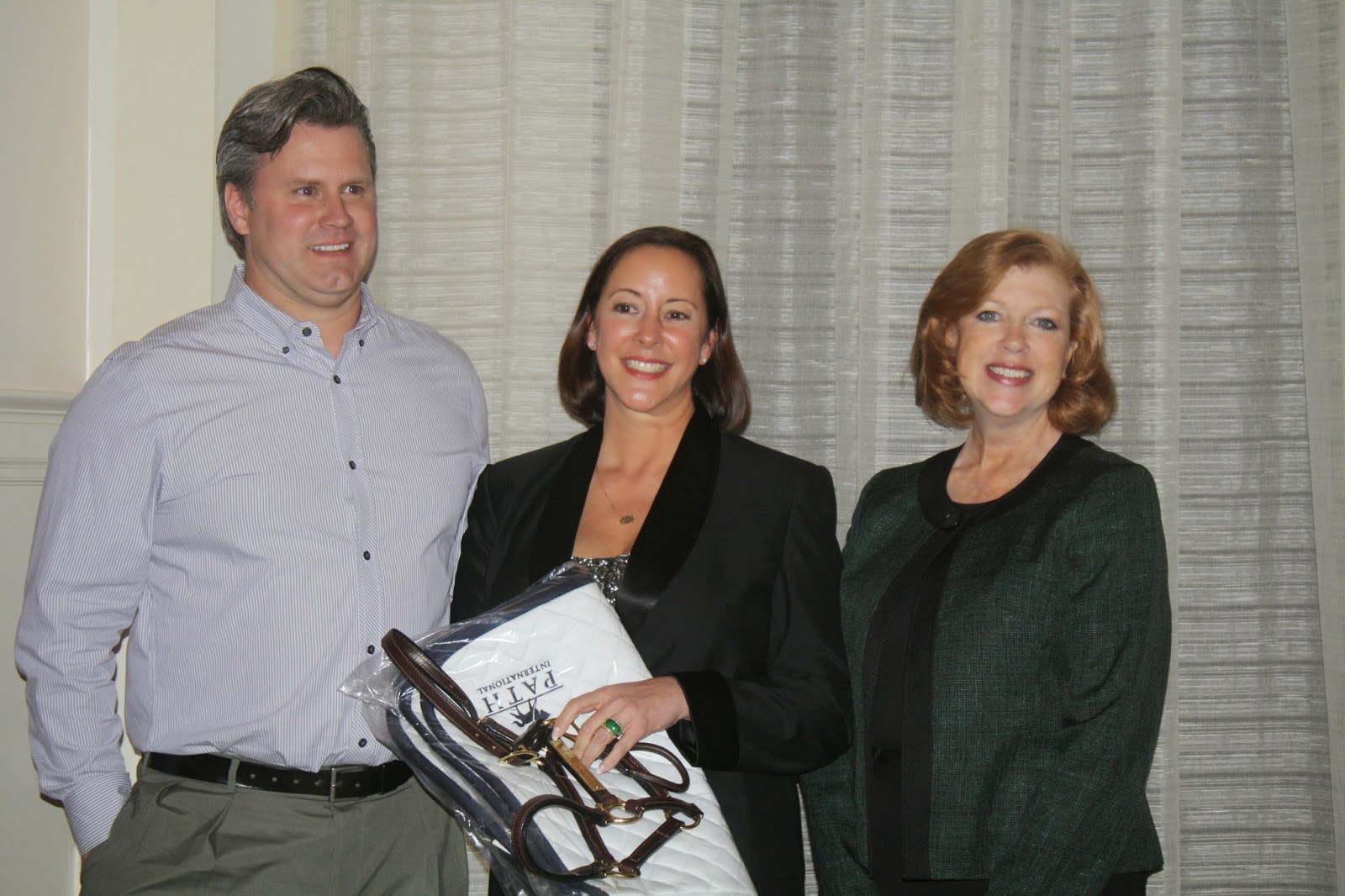
After delays, cancellations and some fancy keyboard work by various airline employees, Kris made it to the 2014 American Morgan Horse Association Conference in Raleigh, NC. Luckily our webmaster Katie L. moved to the Raleigh-Durham area a few years ago so Kris had a local guide and taxi available after her airline adventure. Rosie's breeder, Kevin Dolan, was able to share the spotlight at the awards ceremony.  
Kevin Dolan, Ling Fu Wiley-AMHA director-at-large, Kris Lager
The AMHA put on a great show. Every award winner at the banquet had a short video with a narrative read live. They posted it on YouTube so we can share it with you. Rosie's video
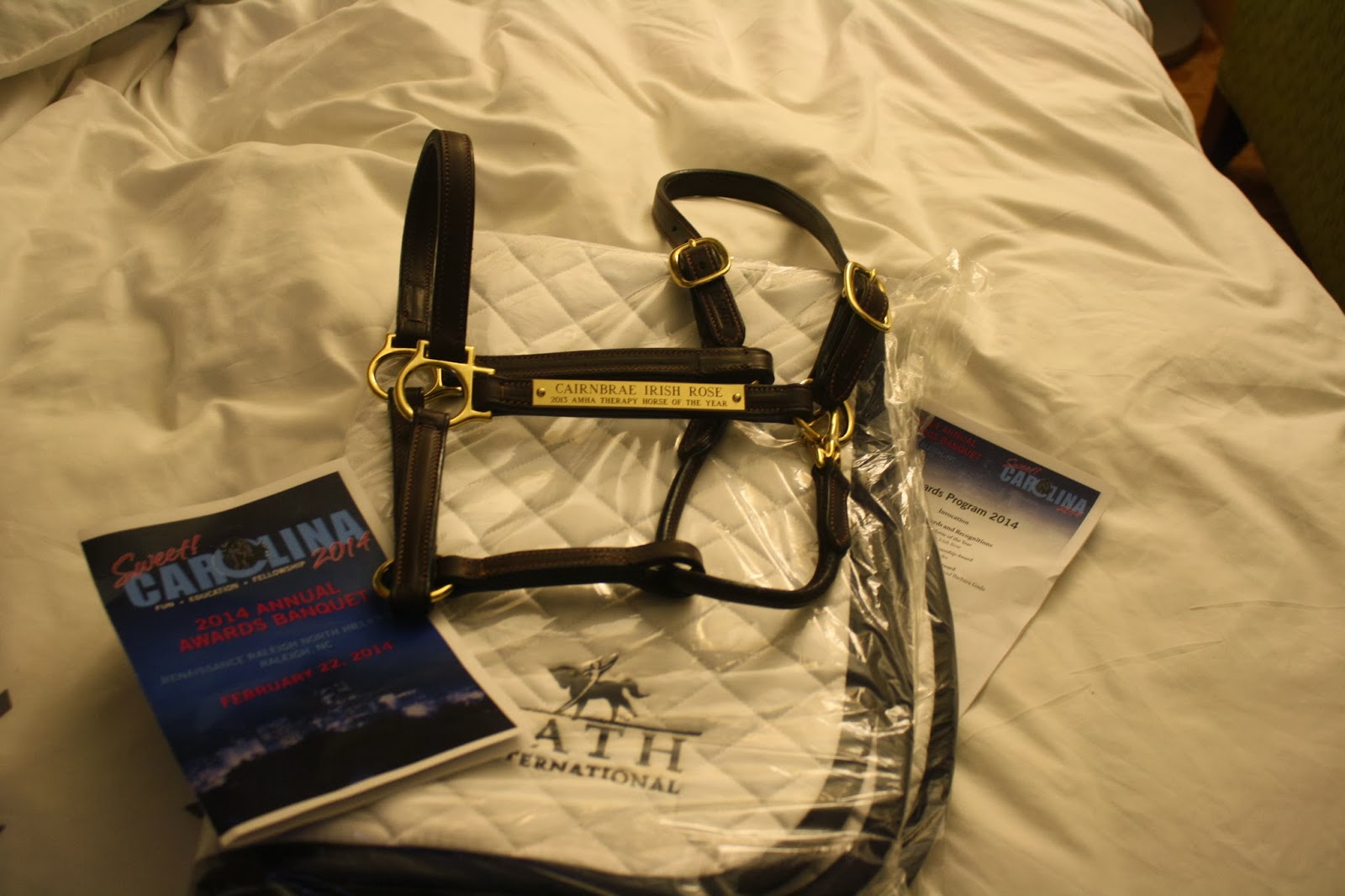
Kris was so excited she didn't even realize they'd set it to music! Rosie is going to look super stylish in her new leather halter and saddle pad.  

Rosie's new bling.